How To Watch Double Indemnity as a Crime Fiction Writer
This is the first in a series on how to read, and how to watch, crime stories not as a spectator, but as a writer.
Every noir, neo-noir, mystery novel, true-crime documentary, and thriller offers lessons in craft. The task is to resist immersion in the work as a passive consumer, and instead keep the work at arm’s length: to examine it clinically, forensically, like a body on a slab. That may sound hyperbolic, but studying what works makes it easier to replicate those effects in our own writing. Not by copying plots, but by absorbing underlying principles.
Double Indemnity is a good place to start, largely because it remains a masterclass in narrative momentum and character logic. Though it’s a film, it can be “read” using the same muscles we use for fiction, via examining the mechanics behind its storytelling.
Double Indemnity as a Crime Fiction Text
The 1944 film routinely appears on lists of essential noir, alongside Touch of Evil, The Third Man, and Diabolique. Written by Billy Wilder and Raymond Chandler and directed by Wilder, it’s foundational to the genre.
From a crime writer’s perspective, the film’s greatest asset is its anti-hero protagonist, Walter Neff. His progression from affable insurance salesman to double murderer is chillingly logical. Each step follows cleanly from the last, like a practiced sales pitch moving from hook to close.
The central question the film asks is deceptively simple: what does it take to turn an ordinary man with a stable life into someone willing to risk everything? The answer lies in the motivation. Love, desire, ego—and $100,000—are sufficient. Neff engages with the crime intellectually and emotionally, which makes his descent believable.
The opening is deliberately mundane until Neff’s routine sales call introduces him to unhappily married woman Phyllis Dietrichson. That moment destabilizes him, and the plot unfolds from there: seduction, conspiracy, and a murder disguised as an accident.
Without Neff’s particular strengths and flaws, there is no story. He is protective, susceptible to manipulation, and fatally confident in his own cleverness. Those traits allow both the crime and the script to function.
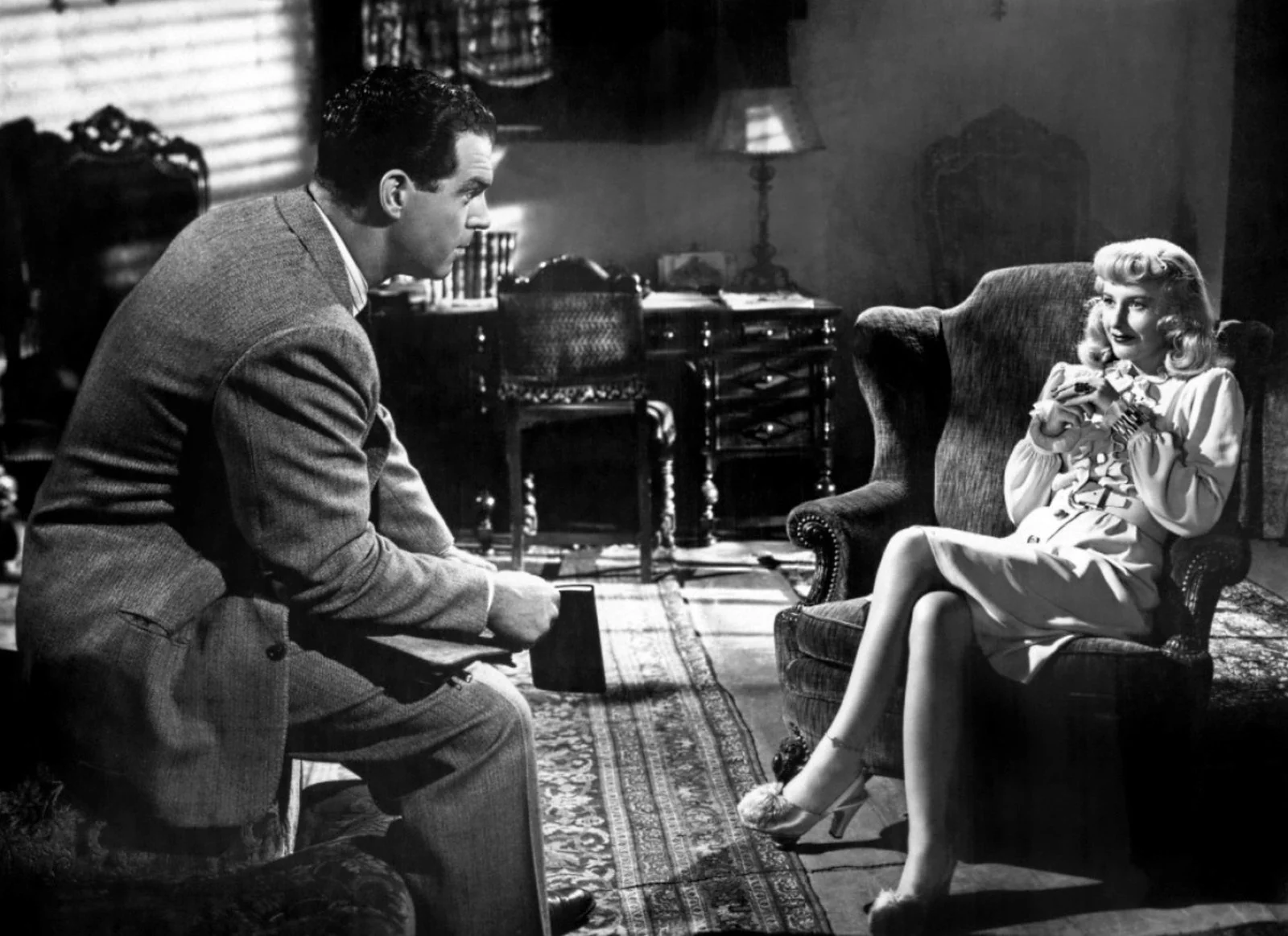
Walter Neff explains to Phyllis Dietrichson how it will all go down in Double Indemnity, as if she doesn´t already know.
The Anti-Hero Without a Backstory
Notably, Neff is not introduced as a man desperate for change. Unlike many modern crime protagonists, he is not fleeing a miserable life. He has no tragic backstory, no buried trauma. He simply exists in the present.
This makes him unusually malleable. He becomes, in many ways, raw material for Phyllis Dietrichson—a classic femme fatale who exploits his competence and vanity. This dynamic, however dated its gender politics may now feel, is essential to noir’s moral framework.
Phyllis doesn’t just manipulate Neff emotionally; she engages his mind. She presents him with a flawed murder scheme, and he cannot resist improving it. The crime becomes a professional challenge. In refining her plan, he brings out the best of his ingenuity and the worst of his character.
Crucially, Neff is never passive. He makes decisions at every stage. He is even given a clear opportunity to walk away and accept a safe desk job. The scene may run long, but it reinforces a vital point: Neff is not a victim. He is responsible.
Empathy as a Fatal Flaw
What makes Neff compelling is that his primary flaw is not cruelty, but empathy. He believes Phyllis has been neglected, possibly abused. That belief, whether true or not, allows him to justify his actions.
His second flaw is his intelligence. The same rhetorical tricks he uses to sell insurance, he uses to deceive himself. He imagines clever hypotheticals, like running a rigged roulette wheel, rather than confronting the reality of murder. His confidence that he can outsmart both the system and his mentor, insurance claims inspector Barton Keyes, seals his fate.
Neff is ultimately undone by his own self-deception. He was just smart enough not to get away with it.
What Crime Writers Can Learn
By the end of the film, Neff is exposed and mortally wounded, yet oddly reconciled. His confession restores a sense of order, and his final act, in selflessly protecting Phyllis’s daughter, reasserts the humanity that enabled his fall in the first place.
This balancing act is difficult but instructive. Neff remains sympathetic not because his crimes are excused, but because they emerge organically from recognizably human qualities. He is neither a cipher nor a monster.
One key takeaway for crime writers is to resist flattening characters into moral absolutes. Empathy, protectiveness, and intelligence can be the very traits that enable violence. That tension is where noir exists.
Another lesson is restraint. A full character does not require an exhaustive backstory. Modern storytelling often indulges in explanatory trauma, but Double Indemnity demonstrates the power of omission. As in Richard Stark’s brutal and inventive Parker novels, character emerges through action more than exposition.
There is much more to say about Barton Keyes and the role of systems and institutions in crime fiction, but that deserves its own discussion.
For now, consider this writing assignment: watch Nicolas Winding Refn’s Drive and look for parallels between its protagonist and Walter Neff. How does the era shape their moral limits? Like good investigators, crime writers learn by making connections.
Matt Henderson Ellis is a crime fiction editor and author. Learn more about developmental editing services here.