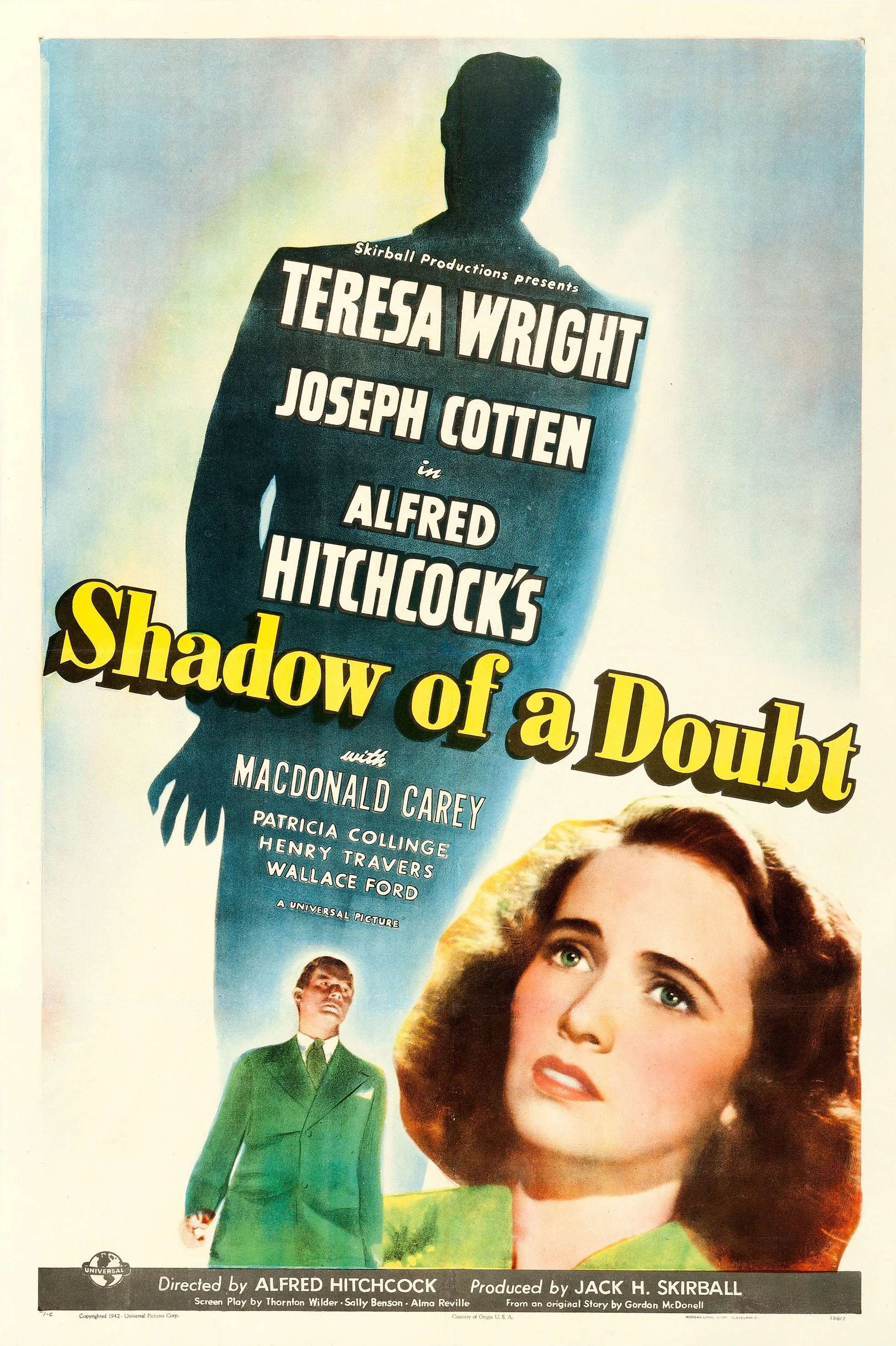
How to Watch Shadow of a Doubt as a Crime Fiction Writer
The second in my series of essays on how to analyze classic and contemporary noir and crime films and books as a writer to glean craft lessons.
Shadow of a Doubt was Alfred Hitchcock’s favorite of his films. Beloved by noir fans, the 1943 thriller is both a genre-defining classic and a film that quietly subverts the conventions of crime storytelling.
For crime fiction writers, it offers an unusually rich study in antagonist construction, moral complexity, and psychological mirroring. The script—by Thornton Wilder, Alma Reville, and Sally Benson—is sophisticated and literary, and Hitchcock’s direction is foundational to the mood and meaning of the film.
Shadow of a Doubt as a Crime Fiction Text
At its core, the film presents a Carson McCullers-esque protagonist displaced westward: a young woman defined by alienation and yearning, set down in a seemingly benign, even bucolic, environment. Into this setting enters a lethal and compelling villain.
What the filmmakers achieve is an antagonist worth sustained attention—not just as viewers, but as writers of crime fiction.
Long before narcissistic personality disorder became part of the cultural lexicon, Shadow of a Doubt gave us Uncle Charlie Oakley: impeccably dressed, charming, and almost entirely without conscience. His first rube is the audience.
Sympathy for the Devil: Manipulating Audience POV
The film opens with a deliberate act of misdirection aimed not at the characters, but at us. Oakley (Joseph Cotton) is introduced impeccably dressed — with a cigar in hand, even while napping. When he learns he has two unexpected and unsettling visitors, the film solicits our sympathy for his character. We know nothing about him beyond surface cues, which are enough for us to hope Charlie eludes the unwanted guests, who ominously surveil him from outside his boarding house.
In short, he is introduced as a protagonist in peril.
It doesn’t take long for those sympathies to be subverted. To evade his pursuers, Oakley heads west, moving in with his sister’s family, including his niece, also named Charlie (Teresa Wright). Once embedded in the domestic space of the film, his manipulative personality becomes apparent, and we begin to suspect he was being chased for good reason. This opening alignment is crucial. It allows the audience to experience Oakley in the same way as young Charlie. As her image of him is gradually corrupted, so too is ours.
Is Oakley who he claims to be? And were we wrong to trust his point of view?
This is a clever and essential narrative maneuver. Each revelation is shared with young Charlie, and the audience takes pleasure, albeit a grim one, in watching her gradual awakening to his true nature. The film demonstrates how such predators move among us unnoticed until the moment they bite.
Remarkably, the filmmakers manage to make a sociopath sympathetic, up to a point. We endow him with our own humanity, filling in what he lacks. Because we hope for Charlie, we momentarily hope for him as well. Those hopes are dismantled, scene by scene.
The result is a journey we share with the protagonist rather than merely observe. Oakley is a near-inhuman villain rendered human by point of view.
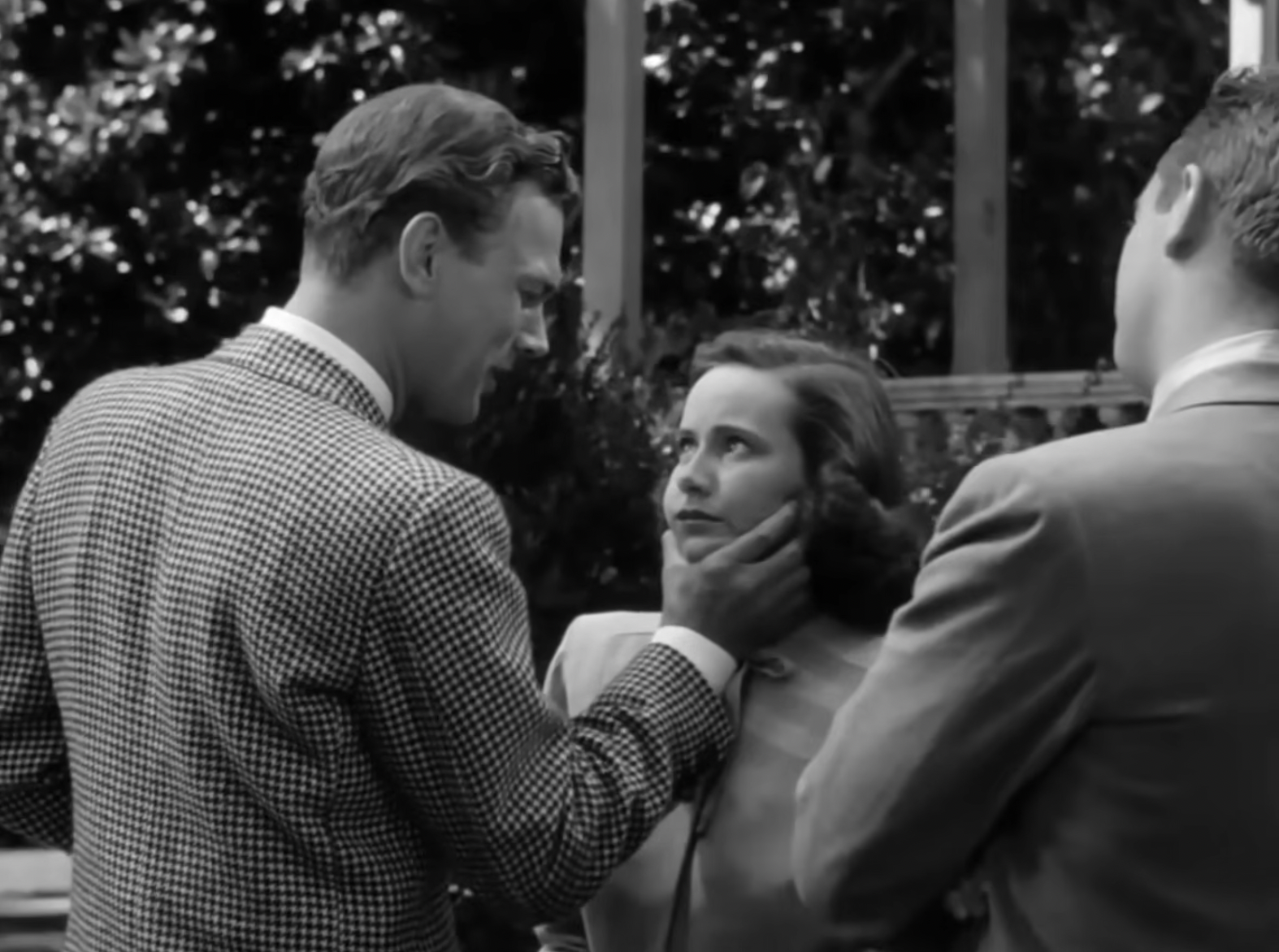
Rough affection from Uncle Charlie
Villain as a Reflection of the Protagonist
That the uncle and niece share a name is no accident. From the beginning, Hitchcock visually binds them in the viewer’s mind—filming them arm in arm, or framed as though about to share a kiss. Young Charlie repeatedly insists on an unspoken connection between them, a kind of telepathy.
Oakley, who understands many things, does not understand human bonding. He can only nod and agree.
He understands people well enough to manipulate them, however, especially Charlie. In acknowledging their “connection,” he does not offer companionship, but instead gives her a ring, later revealed to have been stolen from one of his murder victims. Even so, the story presents both characters as isolated figures, twined together in their estrangement from society.
What they share—the virginal suburban bobby-soxer and the suave proto–metrosexual (American Psycho´s Patrick Bateman’s true progenitor)—is as important as what separates them.
To survive, Charlie must assimilate something of her uncle: his killer instinct, his darkness. She must acknowledge her own capacity for violence and moral compromise. Her growth comes at harrowing risk and at the expense of her innocence as a character.
Oakley, by contrast, has the opportunity to assimilate aspects of his niece (empathy, restraint, and humanity), though he is incapable of growth. He does not even attempt it, and is ultimately crushed as a result.
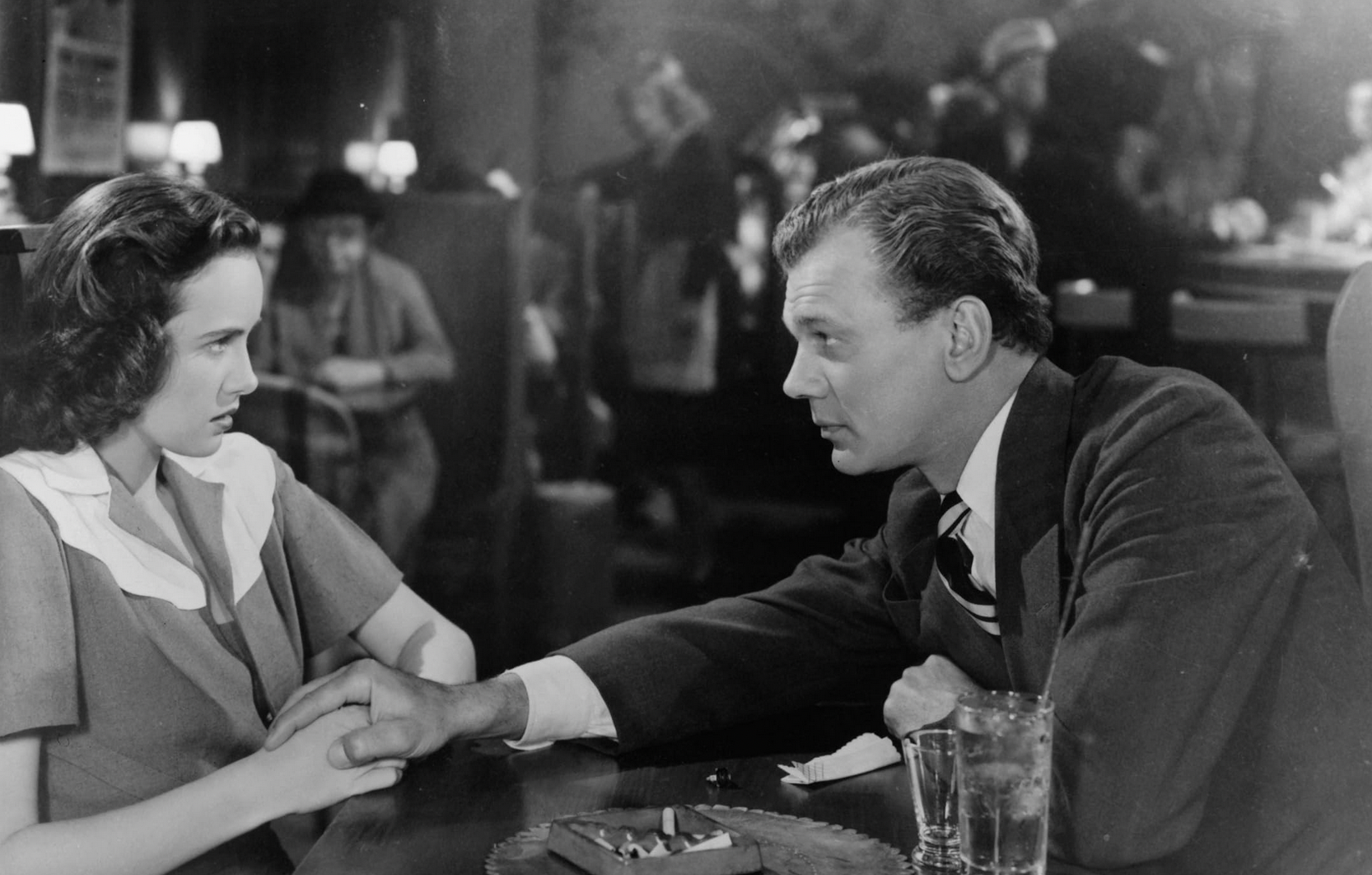
Charlie and Charlie, hand in hand
What Crime Writers Can Learn from Shadow of a Doubt
There are many lessons here, but I’ll highlight a few that recur frequently in the crime manuscripts I edit.
A Worthy Antagonist Elevates the Protagonist
It is often said, but frequently ignored, that an antagonist must be worthy of the protagonist. New writers tend to protect their protagonists at the expense of their villains. But a protagonist is only elevated by the pressure the antagonist applies.
Only a dynamic, fully realized antagonist can draw out the best in your central character.
Oakley is so compelling — so affable yet sinister — that he threatens to outshine Charlie. He doesn’t, because she rises to meet him. By the end of the film, she has come into her own, both as a character and as a young woman.
Make the Conflict Personal
Oakley makes the conflict as personal as possible. He infiltrates Charlie’s home, her relationships, and her sense of self. He takes the conflict from the impersonal headlines and brings it, literally, into her bedroom, which she has sacrificed for his stay. The town in which she already feels out of place all but swoons over Uncle Charlie. Like it or not, they are bound to one another.
Is it necessary for the antagonist to be this close to the protagonist? No. But the antagonist must represent something to them beyond a job to do or a challenge to overcome.
Consider Francis Dolarhyde in Thomas Harris’s Red Dragon: another narcissistic serial killer who externalizes the repressed violence of investigator Will Graham.
For Charlie, Oakley represents an unbridled id: freedom from her parents, her town, and her own constraints. He embodies the dangerous life beyond her shattered, circumscribed days.
In the best crime fiction, antagonist and protagonist exist in a yin-yang relationship. They know each other before they ever meet.
Ultimately, Charlie declares, “I’ll kill you myself,” before she is forced to do exactly that.
Villains Must Be More Than Their Crimes
Finally, resist the urge to make your villain a caricature. With a sociopath like Oakley, this is particularly difficult, as such characters are defined by their absence of empathy, depth, and capacity for human connection.
The filmmakers solve this through the opening point of view. Oakley had our sympathies first. Writers can use POV similarly—not to excuse villains, but to render them intelligible. At the very least, an antagonist must be more than a list of offenses. As a crime fiction editor, I often see antagonists flattened out into caricatures of the ‘bad guy.’ Shadow of a Doubt remains a masterclass in how to avoid that.
Closing Thoughts for Crime Writers
There is much more to be gleaned from Shadow of a Doubt: about setting, about subtext in dialogue, about the use of public and private settings as threat, but the film’s most salient lesson lies in the relationship between antagonist and protagonist.
I’ll save the rest for later posts.
For now, consider this assignment: read Red Dragon and examine Harris’s antagonist. We know what makes him a monster— but what makes him human, or at least recognizable? How does he reflect the protagonist’s own inner conflicts?
That’s where the real work begins.
Matt Henderson Ellis is a crime fiction editor and author. Learn more about developmental editing services here.